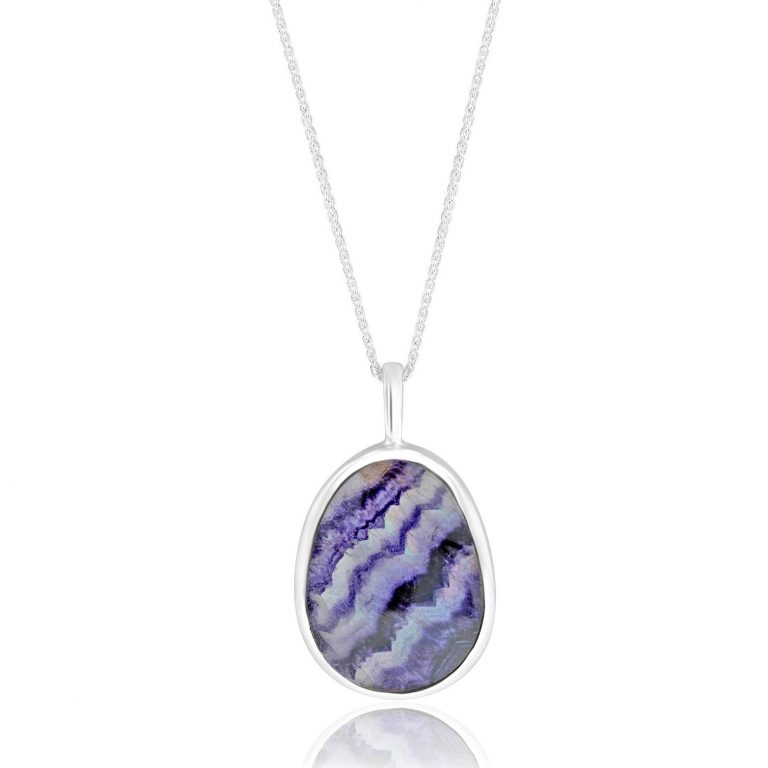
The story of Blue John jewellery begins in the caverns of Castleton, where mineral-rich solutions settled into limestone fractures around 250 million years ago, forming veins of fluorite with striking bands of purple‑blue, yellow and white. The stone’s name is widely thought to derive from the French “bleu et jaune” (“blue and yellow”), a nod to these unusual natural colours that first drew the attention of Georgian and Victorian collectors.
By the 18th and 19th centuries, Blue John was being mined on a small scale and worked into decorative vases, urns and inlaid ornaments, with pieces appearing in grand houses and important collections across Britain and abroad. As demand grew, Derbyshire artisans began to adapt the material for personal adornment, developing a specialist trade in Blue John jewellery that showcased the stone’s banding in cabochons and polished panels.
Today, production remains tightly linked to Castleton: raw Blue John is extracted in limited quantities from caverns such as Treak Cliff and Blue John Cavern, then kept within the village for cutting, polishing and setting by local workshops. Independent houses such as the Blue John Gallery, C W Sellors and W Hamond have spent decades designing and handcrafting collections that range from classic oval pendants to bold contemporary statement pieces, all supplied with documentation tracing the stone’s origin.
Because each vein displays different patterns and colours, no two Blue John stones are identical, and jewellers often work directly with the rough material to orient each slice for maximum effect. This emphasis on individuality, coupled with the stone’s scarcity and its strong regional identity, has made Blue John jewellery highly collectible among lovers of British gemstones and fans of the Peak District landscape.